Home Blog Page 14623

Market Wrap Up – The Cat is Dead

Dead Cat Bounce

Volatility continues. After a 3% bounce on the S&P 500 (NYSEARCA:SPY) and a very respectable 3.6% bounce on the Nasdaq (NASDAQ:QQQ), the dead cat bounce that was today ran out of spring.

It was once again the final minutes of trading that did the rally in, as the Dow Jones Industrial Average (NYSEARCA:DIA) crashed 3.3% in the final hour. It appears short selling traders are getting an early Christmas.

Oil also made a respectable comeback today, rising close to 2%, though oil stocks still saw the pain of the final hour collapse, as Exxon Mobil (NYSE:XOM) lost close to 4 percent into the close. Gold (NYSEARCA:GLD) and precious metals on the other hand did not respond positively to the sudden volatility at the end of the day, with the gold price ending the day down 1.2%.

All eyes will be on China (NYSEARCA:FXI) tonight, as trading opens in Shanghai in a few hours. The Nikkei had an equally volatile day yesterday preceding US market open, trading in a range of over 6% and ending down 4%. If the recent patterns continue, we should see a rise in the Euro (NYSEARCA:FXE) and corresponding fall in the US Dollar (NYSEARCA:UUP) along with a general collapse of emerging market currencies in the next 24 hours.

Finally, bonds got hammered today despite the negative close in equities. The iShares 20+ Year Treasury Bond ETF (NYSEARCA:TLT) is down 3.6% since its highs yesterday.

Given another poor close, look for stocks to open tomorrow gap down, and pressure on the Federal Reserve to call off any rate hikes to increase.

Story continues below

There Are Two Sides To The Market Crash Coin

StockMarketCrash

As we addressed in this article, the floor fell out of global stock markets on Monday. Spurred by an equities market crash in China, UK and then US markets opened into decline. Some of the major indices recovered throughout the latter half of the day to register only single digit percentage overall declines – the Dow Jones Industrial Average (INDEXDJX:.DJI), FTSE 100 (INDEXFTSE:UKX) and the NASDAQ Composite (INDEXNASDAQ:.IXIC) – but the slide has no-doubt ravaged individual portfolios. Further, a slide into yesterday’s close in the US suggests we will open into further weakness this morning. The question now, is will this be looked back upon as the beginning of a longer-term bear market, or is it merely an (albeit) severe short-term correction. Additionally, if the latter of these two proves the case, is there a buying opportunity to be taken? Let’s have a look.

First, let’s consider the argument for a longer-term downturn. Basically, China has looked like it is in some trouble for at least the last few months, and probably more. Growth is down – as low as 4% by some estimates – and both individual and private appetite for taking on debt is almost non-existent. The Chinese government has taken some drastic measures recently to try and avoid yesterday’s collapse, including halting trading and devaluing its currency, but so far these measures have proven futile. So why is it such a big deal if China slows? Well, China is a large-scale exporter, but also imports heavily. However, in a bid to balance trade, the Chinese government has leaned towards reducing imports and increasing exports over the last 12 months. This was one of the primary drivers behind the devaluation of the yuan we saw earlier this year. This shift has led to some big changes in import revenues for key developing trade regions globally, however. This year alone, Chinese imports from the EU have declined nearly 13%. From Australia, more than 25%. Additionally, many developed nations and the vast majority of Asian nations rely heavily on Chinese demand for their commodities. South Africa has seen a 40% dip in its exports to China over the last six months. It is this sort of global withdrawal of resource driven capital that can filter through to wider negative implications.

However, of course, there is also an argument for the opposite situation. News media has also widely reported over the last few weeks that the US Fed could be looking to hike its base rate at the end of September. The implications of this are double edged – first that it allows the US to regain some element of control of its current monetary situation. Second, that higher borrowing costs could cripple already weak growth. The fact that this Chinese (and wider) equities market decline has happened now may be the factor that forces the Fed to change its mind. Elsewhere, the situation is similar. Japan, the UK and Europe are all looking at tightening monetary policy near term (i.e. before the end of the year) and this current situation may translate to a global period of extended loose policy. We are already overheated in major markets, so this is a dangerous approach as we are suggesting a reflation of what are already bubble proportions in many industries – but from a medium term profiteering perspective – is this such a big deal? Longer term, yes. Near term, all it means is there may still be some of the ride left in the latest bull market. Of course, the trick will be knowing when to get off. As yesterday’s action shows, things can turn around quicker than we thought possible.

So that’s where things stand. We could be headed for the next recession regardless of response, but there is a chance that the US interest rate hike has the potential to be the deciding factor in medium term global conditions. In other words, let’s see what Yellen does. At this point, her response looks more important than the short term participant response to an equities market crash.


Story continues below

Markets Go Crazy As October Support Tested

Stock Market Roller Coaster Freakout

It’s days like this when market wrap ups sound like something out of a satirical newspaper. Headlines over the weekend were focused on the – apparently incredible – fact that the Dow Jones (NYSEARCA:DIA) had lost 1000 points in just one week. How about 1089 points in a single day? That’s what happened within the first 5 minutes of trading today as the Dow plummeted as low as 15,370.

And then it appeared as if the Godzilla of all buyers descended on Wall Street and rocketed the Dow back up over 1100 points, all the way to 16,459 by midday. The trading range for this one day was over 7%. That is equivalent to the trading range of the Dow since December 2014.

October 2014 support at 15,855 was broken at the open, though regained by the end of the day. It remains to be seen if that support will be held or if we are headed even lower. It may largely depend on action in China tonight.

As volatile as a 7% trading range sounds for the Dow, the Nasdaq had an even crazier day with a trading range of over 9%. It was so volatile that the PowerShares QQQ Trust which tracks the Nasdaq couldn’t even track it today at the open, as it had a trading range of an unheard of 21% from lows to highs today.

Leaders like Netflix (NASDAQ:NFLX) were the epitome of volatility today as shares dropped as much as 18% in five minutes, climbed to as much as a 5.4% gain, only to close down 6.8%.

The Volatility Index (VIX) spiked so high today that the Chicago Board of Options couldn’t even open it up for trading for nearly half an hour because the price of options on which the index is based were too volatile to be calculated. When it finally opened for trading, the VIX spiked to as high as 53.3, racing down to 30 by midday, and then spiking back up to close at 40.74. The VVIX, which measures the volatility of VIX options, the so-called volatility of volatility itself, spiked to all-time record highs.

And again, it was the last few minutes of trading that really exemplified the whole day. By 3:34PM EST, 26 minutes before the close, the S&P 500 (NYSEARCA:SPY) was sitting at 1880, but within only 12 minutes was back up to 1924.5, a 2.4% move in the space of only 720 dizzying seconds.

In the final 14 minutes of trading however, the index fell back below the psychologically important 1900 mark to close the day at 1894. After hours trading has the S&P down about another full percent.

The final 14 minute plunge suggests that we will open even lower tomorrow, and that the selling and volatility is not over.


Story continues below

Can Addyi Really Live Up To Valeant’s Billion Dollar Price Tag?

Sprout Pharmaceuticals

On August 18, 2015, the FDA announced it had approved flibanserin. Known commercially as Addyi, the drug is being touted as a sort of female Viagra – designed to increase a woman’s libido and treat a condition called hypoactive sexual desire disorder (“HSDD”), which involves low or no sexual desire in women that is not related to pre-existing conditions such as depression or similar psychological disorders. Just 24 hours after the approval, Valeant Pharmaceuticals International, Inc. (NYSE:VRX) announced an agreement to acquire Sprout Pharmaceuticals – the company that developed Addyi – for $1 billion cash. Valeant has had a tough month, currently trading about 15% down on annual highs recorded in July, but the acquisition of Sprout could prove to be the catalyst behind a reversal in the company’s fortunes. Having said this, there are still concerns surrounding both the safety and the efficacy of Addyi and there is an argument to be made that a $1 billion cash acquisition is risky. So, with this said, let’s have a look at both sides of the story, and try to ascertain whether the move is a positive one for Valeant shareholders.

First, a look at the drug itself. Flibanserin is what’s called an agonist of three separate receptors in the human body – 5-HT1A, 5-HT2A and D4. The first two of these receptors mediate the production and distribution of serotonin in the human brain, while the third is associated with dopamine production. To simplify its mechanism of action, flibanserin binds to each of these receptors and stimulates production of their associated hormones. The release of serotonin is associated with reduced inhibitions, while the release of dopamine is associated with sexual excitement.

So where are the issues? Well, first of all, nobody is really sure how big the market is for this treatment. News media reports that up to 10% of all women in the US suffer from HSDD, which would put a rough estimate on the potential treatable population of 15 million. However, there are some limiting factors that reduce this number. First, the drug will not be available over-the-counter. As mentioned, and as we will address shortly, there are still concerns about its safety, and the FDA has stipulated it must be prescribed by a physician as opposed to merely served in pharmaceutical stores. Further, it is not an “on demand” treatment like Viagra. Users must commit to a daily dosage and – at the same time – avoid alcohol. These things are likely to weigh on mainstream adoption.

Regarding safety and efficacy, the FDA approved Addyi based on three six-month trials across a sample size of approximately 2500 women. Across the trials, Addyi patients reported between just 0.5 and 1 additional sexual encounter a month versus the placebo arm. Further, on a scoring scale of 1.2 to 6.0, the Addyi arm reported an increase in sexual desire by a score of only 0.3 over placebo. Across all three trials, an average of just 10% of Addyi patients claimed an improvement in sexual satisfaction. Alongside this questionable efficacy, more than 10% of all patients suffered adverse event side-effects, the most common of which were dizziness, nausea and fatigue.

The question that needs to be asked is how many women are likely to accept side-effects like these as part of a daily regimen that has what amounts to a 10% chance of increasing their sexual satisfaction? With a price point of around $5000 annually, Valeant needs around 200,000 US women to take Addyi once-daily for 12 months to recoup its initial investment. With a strong marketing push, the company could easily hit the 200,000 adoption number, but how many of these 200,000 continue to take the drug after trying it out will be the key statistic.

So, to address the initial question of whether this is a good move by Valeant for its shareholders, probably not. In order to turn the treatment into the blockbuster that its one billion-dollar acquisition price tag commands, Valeant needs high-level and long-term market adoption. Market penetration at the scale required for vindication of the company’s costs is not normally associated with a treatment with relatively low-level efficacy and a questionable safety profile. Of course, Valeant will not let a one billion-dollar acquisition fail easily. The nature of the treatment makes it very easily marketable, and the company will spend a lot pushing its adoption. However, one thing is for sure – it is not a female equivalent of Viagra. Viagra generates between $1.5 and $2 billion a year for Pfizer Inc. (NYSE:PFE), and at a generous estimate, Valeant will be lucky to see Addyi hit 10% of this number.

More from Market Exclusive:

  1. What Is the Real Cost of AstraZeneca’s Eye Cancer Flop?
  2. Frost Closes SciVac Deal, A Potential Blockbuster Lineup in Hepatitis?
  3. AstraZeneca Might Just Have Tapped Into 90% of a $13BB Market

Story continues below

S&P 500 Breaks Critical Support, Gold Soars

Freefall

It seems like only yesterday we said the following:

Judging by the late sharp move down in equities 5 minutes before the close, indexes are likely to open down tomorrow morning at the bell, with support at 2040 on the S&P getting closer to being tested for a third time.

In fact, that actually was yesterday.

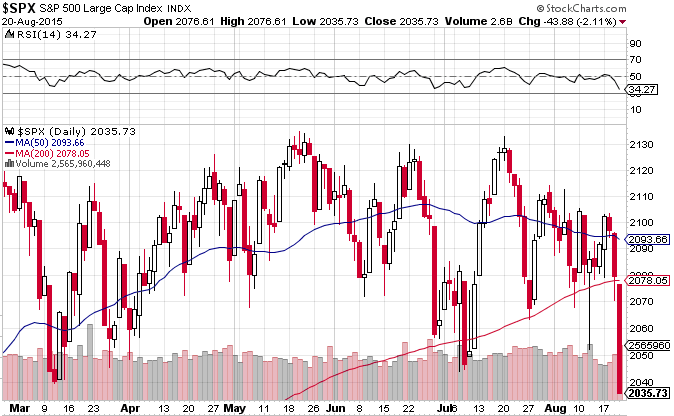
Today, the S&P 500 (NYSEARCA:SPY) has finally, after six months of zigzagging since February, broken critical support at 2040 to close the day at 2035. Following the freefall in the last 5 minutes of trading yesterday, the market opened down hard and continued down for most of the rest of the day, seemingly stabilized until the last few minutes once again. It was the last few minutes of trading that had stocks finish with a final tumble, this time 12 points, which finally broke the 2040 support line.

S&P 500 SupportThe next major support is now 73 points away at 1972, and after that, the October 2014 lows at all the way down at 1820. Stocks still have a chance to bounce off of current support which was only marginally broken, but given the dismal close and the concurrent clear break of the 50 day moving average, chances are small. Strong bounces tend to be foreshadowed by a strong close to the day, which we did not see today.

Ironically, it is the Nasdaq (NASDAQ:QQQ) that may offer the best hope that the broader market can rebound from here. Though tech stocks had an even harder selloff today with leaders like Netflix (NASDAQ:NFLX) and Facebook (NASDAQ:FB) losing 7% and 5% on the day, the Nasdaq itself is more healthy from a technical perspective. It has neither broken the 50 DMA nor broken February support yet. If the Nasdaq can bounce from here, it can take the rest of the market with it.

Nasdaq SupportEither that, or the S&P will bring down the tech sector.

Oil (NYSEARCA:USO) showed some signs of life at the open, but that quickly faded as the day closed with oil down another half percent on the day.

The only ones cheering today are the gold bugs, as gold (NYSEARCA:GLD) continues its climb, taking gold stocks with it. Gold miners (NYSEARCA:GDX) have had a particularly good week so far, climbing nearly 20% in the last 5 trading sessions.

Where we go tomorrow may depend on overnight action in Asia. China’s Shanghai Composite has lost 8% in the last week, with ADR’s of Chinese large cap stocks (NYSEARCA:FXI) down 10% since August 10th, and remarkable 29% since topping. If China continues its freefall overnight, the chances of a waterfall decline in the S&P at least down to the next support zone at 1972 on the S&P increase.

May we all sleep well tonight. We’ll need it.


Story continues below

Is Lion Biotechnologies Really Worth $320 Million?

Lion Biotechnologies

Just last week, Lion Biotechnologies, Inc. (NASDAQ:LBIO) reported a second-quarter 2015 loss of $6.4 million. The company is currently trading at $6.80 a share – just shy of 55% down on 2015 highs back in May and more than 90% down on its 2011 IPO. Despite these declines, a number of ratings agencies have the company at a “buy”, and many of these have reiterated this rating just recently. So, with this said, let’s try and figure out what’s going on, and whether this company would make a potentially rewarding allocation to a biotech portfolio.

The science

The best way to go about this is the first look at the company’s treatment, and then try and figure out why it has lost such a considerable portion of its market capitalization over the last few months. Lion is an oncology biotech, which uses what it calls tumor-infiltrating lymphocytes (“TILs”) as therapeutics against (at the moment) metastatic melanoma – or skin cancer. The science behind this one is pretty complicated, but basically, the company takes some of the tumor from a patient, and extracts naturally occurring TILs from the sample. In pretty much all solid tumor incidences, a patient’s body will create natural TILs that target cancerous cells in the early stages, but the cancer cells quickly adapt to “hide” from the immune system, and evade attack. Ex vivo, Lion replicates the naturally occurring TILs to the tune of billions, and then reintroduces them into the patient. The result is a sort of shock and awe treatment as the billions of TILs overcome the immune system evasion and attack tumors.

Clinical progress

The company has a few ongoing clinical trials, but the one that will undoubtedly prove the driver behind any market revaluation over the coming few quarters is the upcoming phase II trial of its lead candidate – LN-144 – targeting metastatic melanoma. The therapy received orphan drug designation back in June for a late stage indication, and the company expects to initiate during second half of this year, with completion targeted for the latter half of 2019.

Some concerns

So, to address the ratings agency element of this company – it remains unclear just what these analysts see in it. We got some phase II data from a study conducted by the National Cancer Institute (NCI) and Lion at the end of last year, targeting stage 4 melanoma under TIL therapy treatment. The report announced “positive” results, but a look at the numbers revealed an overall response rate of 54% (not bad) and a complete response rate of 13% (not great at all). In other words, the treatment looks to be effective to some degree in very late stage melanoma patients, but across 101 patients (which is a very small sample size for this type of cancer), is far from promising. Further, the press release announcing these “promising” results came in December last year – eight months after the company issued an almost identical release outlining the same results, from the same trial. In short, it looks as though the company is reissuing releases to garner investor attention without any real underlying developments. The same pattern of non-news press releases is illustrated at the company’s website, where it has announced the publication of a few articles co-authored by one member of its research team and the leasing of a new research space. Adding to the concern is the resignation of the company’s CEO at the end of last year, and the subsequent revealing of his connection with the Galena and Dream Team Group stock promotions.

Now, it is important to say we are not suggesting in any way that Lion is cause for concern, and its lead candidate (as well its underlying clinical technology) has shown some level of efficacy in the clinic. What we are questioning is the company’s current market capitalization of more than $320 million. Lion has not yet generated any revenues, and has funded its operations to date through numerous stock issues. With the LN-144 trial not set to complete before 2019, there will likely be numerous further issues that add to the 47 million shares currently outstanding, each of which will be dilutive to early investors’ holdings.

All said…

What it comes down to is this: Lion is developing a therapy that has the potential to treat pretty much all solid tumor cancers. The market potential is huge. However, with an already massive number of outstanding shares, lacklustre trial data and a seeming over reliance on one lead candidate (not to mention the dilutive nature of its capitalization methods) the company is a gamble at current rates.

Story continues below

Riding the Mechanical Bull Market Getting Tough

Mechanical Bull Market

It’s common parlance when people say that the stock market is like a roller coaster, but it’s rarely meant to apply to a single trading day. Today’s trading session actually was like a roller coaster. Or perhaps a mechanical bull, or mechanical bear, depending on your perspective.

Just looking that at the Nasdaq (NASDAQ:QQQ), we can see what a dizzying day it was. Within the first half hour, tech stocks were down nearly a whole 1%, deteriorating down 1.25% by mid morning and briefly breaking the 5000 mark. From that point we embarked on a two-hour full percent recovery, topped with another full percent gain in the space of 15 minutes.

But that wasn’t nearly the end of it. In less than an hour we were back down a full percent again, recovering half that loss by 5 minutes to close. And finally, in the last five minutes of trading, we lost a whole 13 points on the Nasdaq, with after hours bringing all major indexes including the S&P (NYSEARCA:SPY) and the Dow (NYSEARCA:DIA) very near intraday lows.

One can point to a Fed leak, over-analysis of comments and words in the FOMC minutes and various speculations about whether there will be a Fed hike in September or not. But what today’s action shows pretty clearly is that nobody has a clue. Traders are split and antsy, and today’s action betrays that uneasiness.

Whatever happens in September at the Fed meeting, it will affect markets heavily at least short term. That much is clear as day.

Gold’s (NYSEARCA:GLD) intraday action on the other hand, looked like a step ladder, as each new burst in volatility in stocks led to a concurrent jump in precious metals. Gold is now 6% off its lows in late July.

Judging by the late sharp move down in equities 5 minutes before the close, indexes are likely to open down tomorrow morning at the bell, with support at 2040 on the S&P getting closer to being tested for a third time.

In the event that happens, those riding the mechanical bull will have to bet on a triple bottom. Those riding the mechanical bear will have to bet that 2040 gets broken.

Story continues below

Synta: An Under The Radar Small Cap With A Catch All Oncology Candidate

Synta

Oncology drugs have been a hot topic over the past six months. A number of triple digit million-dollar deals have come out of the space, and incumbents in the arena have dominated news media. However, there are still a number of small cap opportunities that remain under the radar. One such opportunity is Synta Pharmaceuticals Corp. (NASDAQ:SNTA). With a market capitalization just shy of $300 million at last close, the company is very much a development stage entity. As such, there are inherent risks associated with an allocation. Having said this, it has quietly navigated its way through both a proof of concept phase I and an efficacy rooted phase II, and as we head into the second half of this year, is poised to report phase III readouts on a lung cancer indication. Let’s have a look at the company and try to ascertain whether now is a good time to gain exposure.

Lead Candidate

Synta’s current pipeline includes three primary treatments – Ganetespib, STA-12-8666 and Elesclomol. The first two are what is called an Hsp90 inhibitor (which we will look at the little more detail shortly) and the third is a Mitochondria Metabolism Inhibitor. For the purposes of this report, we will focus purely on the former of the three candidates, as this is the one that will drive Synta’s market potential over the coming 4 to 5 years.

The Science

As mentioned, Ganetespib is an Hsp90 inhibitor – meaning it inhibits Hsp90, a type of protein that serves as a “chaperone” protein. Chaperone proteins do many different things, but to keep things simple, think of them as a sort of protein mold. Client proteins feed into chaperone proteins, and chaperone proteins “form” the client proteins into the task performing proteins they are designed to be. There is a nice mechanism of action video here that visualizes this process. Ganetespib attaches to Hsp90 proteins and blocks them from interacting with client proteins. Tumor cells are (reportedly) more heavily reliant on Hsp90 proteins for both proliferation and survival. Therefore, the theory goes that by inhibiting the interaction between client and chaperone, Ganetespib is inhibiting the result of any potential interaction. The result of the interaction, in this instance, being proteins that contribute to tumor cell proliferation. The beauty of this sort of approach is that it is not limited to one form of treatment. We’ve seen markets get excited about BRAF, HER2 and EGFR inhibition treatment already this year. Cancers associated with all these gene mutations are heavily reliant on Hsp90 interaction, so in theory the treatment can supersede these subsections and serve as an overarching fix all. Obviously, this is further down the line, but the potential is there – at least from a scientific perspective.

Clinical Progress

Synta is currently targeting a non-small cell lung cancer indication, and as we have mentioned, is well underway with a phase III. The trial sees Ganetespib tested in combination with a current chemotherapy drug called docetaxel, currently marketed by Sanofi (NYSE:SNY) as Taxotere, versus docetaxel alone. A phase II study designed to determine a phase III population completed last year, with progression free survival (the primary endpoint) for the combination therapy outpacing that of the single therapy by more than 55% – or 5.3 months versus 3.4 months.

From this phase II, physicians selected just under 850 patients for a phase III enrolment, which is currently testing towards a primary endpoint of overall survival; again, using combination versus single therapy. As mentioned earlier on, interim analysis will hit markets during the second half of this year, with final data slated for the first half of next. Both of these events could be real volatility drivers from a market capitalization perspective. If progression free survival (a secondary endpoint that will likely be addressed in the interim analysis) can fall in line with the results we saw at phase II, there could be real upside potential short-term. After that, all eyes will be on overall survival in the final data.

Financial Overview

From a financial perspective, the company has a little over $95 million cash on hand, which it expects to carry operations through to the second half of 2016. Current and historic burn rate averages out at between $2.5 and $3.5 million, but this is not really indicative of an ongoing equivalent as the next couple of years will likely be more expensive from an operational perspective than the last. This said, with no debt and a phase III underway further capital raises should be a problem (so long as we see promising interim analysis).

Takeaway

The takeaway here is that Synta is one to watch. Investors with an appetite for risk may look to take a position ahead of interim analysis, but progression free survival can be notoriously volatile short-term. As a result, what the interim analysis reveals may not be indicative of the final results. For this reason, for more risk averse investors looking to mitigate their exposure somewhat, a position in anticipation of final data mid-2016 could be a rewarding allocation.

Story continues below

China Crashes Again, PBOC Losing Control

China off a Cliff

Here we go again in China. When bond king Bill Gross had said to us on June 4 that Shenzhen stocks were the “short of a lifetime,” he apparently had no idea how perfect his timing was. It was perfect enough that even he didn’t capitalize on the short he called. And it looks like we’re in for crash round two after a brief reprieve, as the Shanghai index has fallen over 6% yesterday. The large cap iShares China ETF (NYSEARCA:FXI) is down 2%, with the small cap fund China A Shares (NYSEARCA:ASHR) down over 7% today.

It appears that no matter what the People’s Bank of China (PBOC) does to stop the fall, it is only successful short term. They seemingly cannot stop the bleeding for long. The PBOC may nevertheless be the only thin branch between China’s stock market and the abyss of fundamental long term revaluation downward.

This kind of market action does not happen in a vacuum. As much as Keynes and his followers want to believe that crashes only happen because of faulty “animal spirits” where a herd mentality feedback loop inexplicably forms and has everyone suddenly headed for the exit doors for no apparent reason, these things have a cause. That cause is always the central bank.

This seemingly benign chart below is the first clue.

Balance Sheet of the PBOCThe balance sheet of China’s central bank the People’s Bank of China (PBOC) peaked in February at 34.5 trillion yuan. Since then, it has declined month after month, at least through June has the chart shows. If we take a longer view, we can see how much of an aberration a shrinking PBOC balance sheet really is.

PBOC Balance Sheet Long TermThe three circles above show the three major periods since 2000 where the rate of PBOC balance sheet expansion either was severely curtailed or outright reversed. The only way a central bank can expand its balance sheet is by printing the money to do so, and when money is printed, stocks go up, because whether the PBOC is expanding its balance sheet with securities outright or buying something else, the money almost always ends up there ultimately. When that printing stops or slows suddenly, stocks go down.

The first red zone marks a lull period beginning in 2008 where the rate of balance sheet expansion suddenly slowed after a two-year burst from 2005-2007. The expansion picked up again around 2009, but suddenly stopped again in late 2011. And now, we are seeing the same stagnancy in money printing since February.

The iShares China Large Cap ETF consisting of the largest Chinese ADRs dropped 59% in 2008, 32% from May to September 2011, and has fallen 22% since its most recent peak. If we measure the most recent fall against the other two, there is still a way to go before reaching bottom.

There is hope though that this recent crash will not be as severe as what we saw in 2008 or 2011. The reason the PBOC stopped printing so abruptly those years was because of skyrocketing inflation.

Inflation Rate in ChinaIn 2008 it reached 8%, and in 2011 over 6%, and in both cases the central bank tightened monetary policy quickly in response, shrinking its balance sheet. This time, the inflation rate is muted at below 2%, if we assume the statistics are a true reflection of the Chinese economy rather than propaganda. This gives the PBOC more room to run so save the markets. How much saving will be required and for how long is the question.

Incidentally, tracking the Fed balance sheet for forecasting these kinds of moves does not work in the same way because monetary policy is literally clogged at the Fed with over $2 trillion of excess reserves backing up the works due to zero interest rates. Interest rates in China are still above 4% on the overnight rate, so there is still some control over the money supply there.

Story continues below

AGTC Has A Big Advantage In The Orphan Space; And Its Not Biogen

AGTC

During the middle of last week, Applied Genetic Technologies Corporation (NASDAQ:AGTC) management presented at the Wedbush PacGrow Healthcare Conference in New York. For those familiar with the space, you will remember the name as being the small cap that Biogen Inc. (NASDAQ:BIIBannounced gene therapy partnerships with earlier in the year; an announcement that translated to 10 times daily trading volume over the few days that followed, and a close to 30% gain in a matter of hours on the company’s market valuation. The company has since lost the lion’s share of this increase in value, despite no real developments from an operational perspective. The latest management presentation has, therefore, given us an opportunity. First, to take a look at the company’s pipeline with a focus on the Biogen deal, and weigh up the justification (or lack thereof) for the initial gain. Further, in light of the recent correction, to determine if there now exists an opportunity to buy in at a discount at today’s price. Here goes.

First, a quick overview. Applied Genetic Technologies focuses on orphan indications in the ophthalmology space.  Straight off the bat, this is a bonus. Why? Because one of the biggest drawbacks to chasing orphan indications is establishing clinical endpoints. Further, having decided which endpoints to target, agreeing these endpoints with the FDA can be tricky. This, of course, all takes time. However, in the ophthalmology space, endpoints are already well established. This is because sight in humans is considered high priority (for obvious reasons) and this priority has led to a large body of educational institution research in the field. Further, Applied Genetic Technologies cannot only draw on this body of research to establish endpoints, but also identify potential therapeutic paths to these endpoints. For those wondering, the four established endpoints of ophthalmology treatments are visual acuity, visual fields, color vision and contrast sensitivity.

The company uses what is called Adeno Associated Virus (“AAV”) gene therapy. AAV therapy basically means packaging up a virus in a protein shell, which (through a range of delivery methods, varying according to indication) carries through to the nucleus of a cell. In the nucleus, the protein shell breaks up and the virus is introduced. AAV has numerous indications outside of the eye, but there is one advantage of using this type of therapy in ophthalmology. Basically, when the virus is introduced, it produces a very small immune response in retinal cells, which causes them to produce a particular type of enzyme (again, variable according to indication). For indications outside of the eye, when the cells in question die they no longer produce the enzyme targeted at treatment. However, retinal cells do not “turn over” like other cells (i.e. the retinal cells we are born with are the cells we die with). This translates to a potentially lifelong treatment from just one therapy session.

So that’s how it works, where are we with trials? Let’s deal with the lead indications first. These are X-linked Retinoschisis (XLRS) and X-linked Retinitis Pigmentosa (XLRP).

The former occurs when a gene defects translates to their being a missing structural protein in the eye. This causes the retina to “delaminate” and leads to visual impairment. There is currently an ongoing phase I/II trial of AAV using a gene called RS1 targeting XLRS, with a primary endpoint of safety and a secondary endpoint of efficacy (as measured by visual acuity and visual field). The company expects to report preliminary data for this one before the end of the year, and due to its association with Biogen, anything positive could be a real upside driver for the company.

The latter of these two lead indications, XLRP, is related to a missing protein that causes night blindness and progressive deterioration of visual field span. The company has already completed a primate trial that showed promising results, and has a toxicology study slated for the beginning of 2016.

Further candidates include targeting Achromatopsia (ACHM) and AMD, with initial clinical data from a proof of concept trial scheduled before the end of the year for the former, and a target announcement for the latter scheduled during early 2016. For a more detailed breakdown, you can check out the company’s full pipeline available here (bear in mind this is slightly outdated and does not reflect the implications of the Biogen partnership in full).

From a financial perspective, and not including the $124 million scheduled to hit the company’s balance sheet as a result of the Biogen collaboration before it reports its next quarterly results, Applied Genetic Technologies had about $92 million cash at the end of March, 2015. Burn rate over the last few years has averaged out around $2.5 million, but this is likely to increase as the company moves its lead candidates into their respective clinical phases. Despite this increase, however, management has stated that current cash on hand should easily cover completion and data analysis of the ongoing trials for its XLRS and XLRP programs, as well as see through ACHM to prelim data.

So there we have it. A company with no debt and close to $100 million cash in the bank that is set to receive an influx of a further $124 million from a huge player in the space. With an additional $400+ million dollars earmarked as milestone payments for two of its lead candidates, and some wholly-owned candidates that have shown  preclinical promise, Applied Genetic Technologies looks to be one to watch, and may indeed offer a discount entry to a promising pipeline at current rates. Keep an eye on data scheduled for the end of the year as near-term drivers, and updates from the AGTC / Biogen collaboration slightly longer term.

Story continues below