
Home Blog Page 14621

Stocks Have No Direction After Fed Shocker

Surprise Move by the Fed

Well, it seems that Peter Schiff was right again. For months he has been harping on his contention that the Fed never had the intention of raising rates, and he never budged from that viewpoint, other than to say a one-off rate hike was possible and qualifying that he still thought they were not going to hike even a small 25 basis points.

The reaction to the decision was expected, except for the the effect on stocks. Gold (NYSEARCA:GLD) and silver (NYSEARCA:SLV) surged higher along with the accompanying mining stocks (NYSEARCA:GDX). Bonds surged (NYSEARCA:TLT) as interest rates plummeted, and the dollar index (NYSEARCA:UUP) fell just as fast.

The only move that raised some eyebrows is the effect the surprise lack of an interest rate hike had on stocks. The Dow (^DJI) Nasdaq (^IXIC) and the S&P 500 (^GSPC) all sold off on the announcement and then surged, only to sell off again and end the day marginally down. Equities traders clearly do not know what to think from here, given rates have been near zero for the longest time in history. The question on everyone’s mind is, if not now, when? And nobody seems to know the answer.

But the answer, after today, does seem clear to those who understand the Fed’s main fear, which is price inflation. When the consumer price index came in at negative 0.1% yesterday, the chances of a rate hike shrank. It seems likely that the only thing that will get the Fed to raise rates even a tiny bit is higher price inflation. Short of that, there is just no reason to risk cutting fragile economic growth.

The problem is, with rates so low for so long, when inflation finally does start to show up in the CPI, it may be too late for monetary policy to do anything. If the CPI begins to climb in earnest, the economy may not be ready for a rate hike aggressive enough to tame it.

If the Fed broadcast anything today to Wall Street, it is that as long as economic numbers are at least decent and inflation is low, zero interest rates will continue, if not even negative ones. One Federal Open Market Committee member even predicted negative interest rates for 2016.

The other fly in the ointment though is that China is still dumping treasuries at a record pace. China is said to have dumped $300B in foreign exchange reserves in 3 months with the latest figures showing that forex has plummeted from $4 trillion to $3.5 trillion in little over a year. At some point, this will raise interest rates regardless of what the Fed does.

One wonders if Yellen and company are ready for that. Something tells me they aren’t.

Story continues below

What’s Behind Oil’s Volatility?

oil

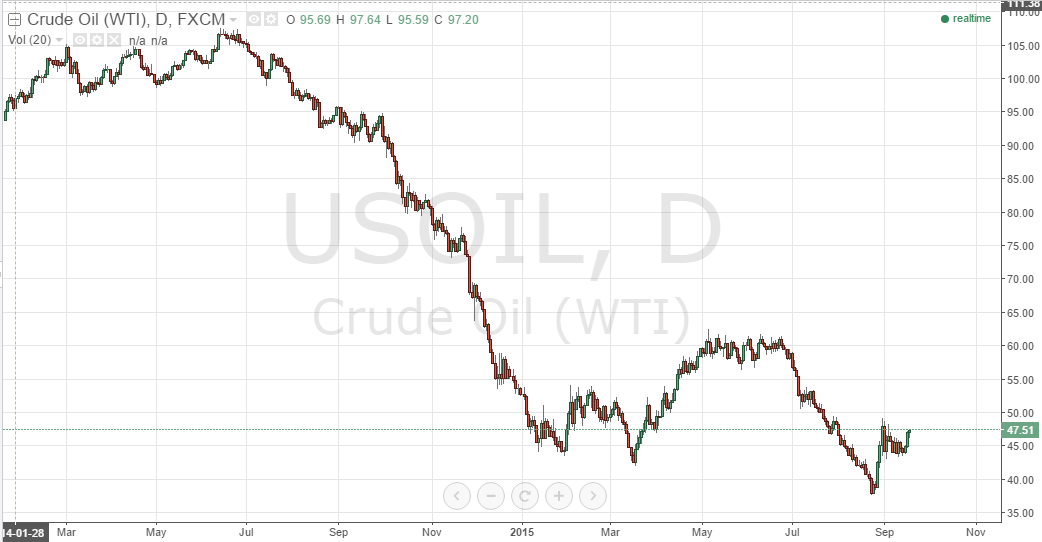
The last 12 months or so have been extremely volatile in crude oil. From 2014 highs of close to $110 a barrel, WTI declined over a seven-month period to close out the year of $45 a barrel – a 69% decline. Year-to-date, this volatility has continued. The price per barrel has fluctuated from highs a little over $62 to lows of $37, and now trades a few dollars above where we opened the year. Major energy ETFs such as United States Oil (NYSE:USO) and the Energy Select Sector SPDR ETF (NYSE:XLE) are mirroring this action. Markets are looking at these prices and questioning the driver behind all the volatility. Really, it comes down to two things – uncertainty and misinformation. A number of conflicting global economic (macro and micro) factors are playing into crude pricing at the moment, and this conflict is creating a push pull pricing effect. So, with this in mind, here’s a look at what’s playing into the price at the moment, and how we can use these factors to form a crude strategy for the next few months.

crude


US Storage Supply

So, what’s weighing on oil?Well, the primary driver behind the steep decline seen throughout the latter half of last year and the first few months of this year was supply. A perceived US glut of crude supply led to wide news-media reporting on the issue, and investors sold out of their crude exposures accordingly. In reality, much of the supply speculation proved unfounded. A look at the EIA weekly supply stats reveals intra-annual fluctuations in supply. The comparisons used to stir up attention in the media were between highs and lows of these fluctuations – thus essentially invalid. However, sometimes (often) sentiment drives markets rather than reality.

Iran Sanctions

Another factor that has weighed on oil is what is happening in Iran. Again, however, the idea that the removal of trade barriers between Iran and the Western world will translate to oversupply is largely conjecture. Admittedly, Iran has reserves that would put it as the fourth largest oil producer in the world – somewhere around 160 million barrels proven resources. On a daily basis, however, it would only be able to produce 3.1 million barrels – a tiny portion of the more than 93 million barrels that make up daily global demand. Further, a large portion of its reserves are held offshore in tankers – somewhere around 35 million barrels. The quality of crude held in these tankers has been subject to debate recently, as has the quality of the Iranian oil infrastructure (i.e. its wells and processing facilities). At best, analysts expect around to be able to export around 180,000 barrels daily.

China and the US

Finally, we got what’s happening in China and the potential for a US rate hike putting downside pressure on the price of oil. The Chinese economy is slowing, and currently sits around 8 million barrels per day – down from 10 million barrels earlier on in the year. Combine this with a Federal Reserve rate hike (which would likely reduce US oil demand based on a reduction in capital spending from US industry) and you’ve got your justification for a slump.

Corrections

However, and as the chart shows, we are seeing upticks, and even bullish corrections, over the last couple of months? Why is this? Well, the first two reasons (US storage and Iranian export driven supply glut) are unfounded, and while wider market perception has driven the price down, market efficiency looks to have led to a correction of at least a portion of this downside momentum. Looking forward, don’t be surprised if, as markets further realize the realistic implications of these two factors, the price of oil corrects further to the upside.

Profit Taking

There is also likely an element of profit-taking from speculators on the short side of oil that initiated positions during 2014 highs. The uncertainty surrounding the forward economic strength of both China and the US (not to mention Europe) is enough to force short covering in any market. Especially one that – over the last 12 months – has proven so elastic to external influence.

Looking Forward…

So what can we expect going forward? Well, news-media will report a $50 price roof for a number of reasons. Those already mentioned as well as the ability of OPEC to manipulate supply with the goal of reducing the attractiveness of US shale prices, could – short term at least – force this roof into reality. However, looking forward, it cannot hold. At the peak of the last recession, oil priced about five or six dollars lower than the lows seen during August this year, and from those lows, corrected nearly 300% across a 2 ½ year period. Medium to long-term, look for a reversal around current levels to break the so-called price roof and return some upside momentum to oil going forward.

Chart source

Story continues below

A Rate Hike Looks Very Likely Tomorrow

Rising inflation means rising interest rates

Economists are being polled ad nauseum. Is a rate hike coming or not? How do you know? What are the signs? Admittedly, whoever makes the right call and trades accordingly will make a nice profit. The amount of power now in the hands of 12 people on the Federal Open Market Committee is absolutely enormous. One wonders if any of the people in their inner circle are making trades. How can that be prevented?

In my estimation, a rate hike looks very likely. We are currently at the dual mandate goal of price stability and full employment. The fact that the consumer price index (CPI) fell by 0.1% can be chalked off to continually falling oil prices (NYSEARCA:USO) and the collapsing energy sector (NYSEARCA:XLE). Top officials at the Fed know full well that when the supply side issues for commodities get back into balance, the CPI will shoot right back up.

If a rate hike is indeed called tomorrow, a gap down in stock indexes (NYSEARCA:SPY) will probably be overshadowed by a collapse in bond prices (NYSEARCA:TLT) which have not absorbed the shock of a rate hike in a decade.

What economists seem to be ignoring, and they ignore a lot, is what happens if the CPI reverses and starts climbing higher much faster than anticipated? In that case, the Fed would be forced to continue to raise rates much faster than they in turn anticipated, which would collapse bond prices much further and jack up the rate at which the Federal Government has to pay to service its $18 trillion debt and counting.

Everything, then, rests on consumer price inflation. As long as it stays down, the status quo can be maintained. But if and when it edges up to 2%, 3%, perhaps even 5% over the next year or two, what then? If the Federal Reserve is forced, due to climbing inflation, to raise rates to 5%, 6% or more to say ahead of inflation, how much of Federal tax revenue will be eaten up in paying those rates, given the gargantuan increase in public debt that has piled up since the financial crisis of 2008?

The worst of all cases would be a 1973-74 style stagflation with inflation nearing 10% with a concurrent recession in a debt environment like this. The dollar barely survived the 70’s and only did so with interest rates bordering on 20% by 1980.

There is no way that the US economy could possibly support rates that high given current debt levels. It would result in a Federal default on Treasuries without a doubt.

If inflation starts to get out of control at any point – any point at all – the whole jerrybuilt US economy could unravel. But as long as the CPI stays tame, there is no need to worry. It’s all business as usual. For now.

Story continues below

How To Set Up Against Either Side Of Thursday’s Interest Rate Decision

interest rates

The upcoming US interest rate decision is one of the most widely anticipated economic decisions of the last two decades. However, while the fact that it is about to take place is well-known, its implications are far less certain. This is the case even for those pretty well versed in economics and financial asset markets. With this said, there are a few ways we can set up against the rate decision in anticipation of a range of scenarios, which should serve to maximize our upside in the event that the decision comes out in our favour, and minimize our downside in the event that it does not. So, let’s try and figure out the un-figureoutable.

First of all, why all the uncertainty? Well, interest rates have long been the primary tool for the central bank of an economy to maintain economic stability. When interest rates are low, an economy generally expands, but in order to maintain stable inflation (generally around 2%) a central bank will normally raise interest rates to reduce borrowing and – in turn – private and public spending. You can think of it as a kind of “letting off steam for an economy”. So, since an increased rate hike generally means less industrial and private industry spending, stock markets will normally correct as interest rates increase. Conversely, since interest rates are the primary determinant in the value of a nation’s currency, currencies will usually appreciate in value as interest rates rise.

Things are different, now, however. Inflation is non-existent in the US, so we have this disparity between domestic equities markets (which have been booming for the last half decade), unemployment levels (which are – according to figures, at least – at reasonably low levels), inflation (which as we mentioned is pretty much non-existent) and economic growth (which again, is zero or negative at present).

The question is, then, is the US economy strong enough to withstand a rate hike? Alternatively, will downside pressure on private industry’s ability to borrow money and expand reverse the nation’s fortunes and send it back into recession? This is what nobody knows, and is the root of the dilemma.

So how can we set up against it? Well, normally, in anticipation of a rate hike, investors will shift assets from risk on to risk off, or in other words, out of equities markets and into gold. This is rooted in the fact that equities will generally sell-off as the rate hike constricts the flow of free capital into and out of markets. However, some will argue at the moment that a rate hike reinforces the Federal Reserve’s confidence in the US economy, and can be translated as bullish for its domestic equities markets. Why? Because there is a long way to go before we get inflation and growth. A rate hike now could suggest that we are on the path towards, but far from actually at, the end of the current bull market.

Conversely, loose monetary policy will generally boost stock markets as it suggests a continuation of free capital flow. However, in this instance, it could suggest that the Federal Reserve is taking the lack of inflation seriously, and that it believes it could be a problem going forward. For this reason, equities markets may correct in spite of the loose monetary policy, which again, could lead to an uptick in gold.

So how can we play it? Probably the safest approach is to allocate a majority portfolio to precious metals SPDR Gold Shares (NYSE:GLD) and certain areas of US industry that are relatively immune to the wider economy – health care, insurance etc. Energies are a risky allocation at the moment, and while we will likely see a spike if the Fed raises rates, the questions over how long that spike will remain in place make any exposure to them uncertain. What about those looking to get a piece of the action we are likely to see in equities markets if rates remain low? Major indices – Dow Jones Industrial Average (^DJI), NASDAQ Composite (NASDAQ:^IXIC) – remain the best bet, as these offer upside as part of a wider market buy in in the event of loose monetary policy, but also a (somewhat) protected downside as a result of the blue-chip nature of their constituent entities.

All said, tomorrow is going to be a pretty volatile day regardless of what happens. For those not looking to take an active approach, a majority cash holding might be a smart move, and one that retains capital that then becomes available to allocate in response to post-announcement market behavior.


Story continues below

Two Companies With Near Term FDA Catalysts

stocks

With the US Federal reserve monetary policy announcement just round the corner, you could be forgiven for staying out of the equities markets at the moment. With all the uncertainty surrounding the announcement, any outcome will likely translate to considerable volatility, and a large number of individual investors will have already shifted allocation towards safe haven assets such as precious metals. However, and as we’ve mentioned in the past, the biotech space will often buck wider market trends. Healthcare is an inelastic industry, and as such, it’s constituent companies have the potential to gain strength while the wider market declines. The announcing of promising trial results or FDA approvals can be strong upside catalysts for any biotech – regardless of what other industries are doing. So, with this in mind, here are two companies set to receive FDA approval outcomes over the coming few weeks that should offer up some bullish reprieve in what could be a weak equities space.

Merck & Co. Inc. (NYSE:MRK)

First up we’ve got Merck. On October 2, 2015, the FDA is set to report the outcome of its accelerated approval review for a supplemental Biologics License Application for Keytruda. Keytruda is currently approved for second-line metastatic melanoma treatment, and this supplemental application is one of a whole host of applications designed to expand the range of conditions with which Merck can target Keytruda. In this instance, the company is looking at patients with advanced non-small cell lung cancer that aren’t eligible for platinum chemotherapy (or that have already received it, to no avail). The company submitted the application back in June this year. It’s worth mentioning that the potential market for this one is not huge. About 75% of newly diagnosed patients are advanced enough to qualify for platinum therapy, and only about 20% of these move onto a second-line therapy such as that under investigation. However, with its Keytruda treatment Merck looks to be targeting a wide range of small population indications, rather than a narrower range of indications that have large potential patient populations. As such, while this announcement is unlikely to have too much of an upside impact on the company’s revenues, it should contribute to an improved likelihood of further indications going forward. Further, these indications should build on each other and could eventually contribute a substantial portion to Merck revenues. So what can we expect from the FDA? Well, safety and tolerability won’t be an issue, as Merck has filed for a dosage at the exact same level as that being currently administered for the melanoma indication. Efficacy is based on these trial results, which showed a 45.2 overall response rate across a 313 patient population. Chances are this should be enough to instigate approval – especially with the treatment already in place for another type of cancer. We may see an FDA approval committee release in the coming week or so that gives us further indication as to the treatments likelihood of reaching commercialization. If we do, look for some immediate upside momentum in Merck stock, likely to continue as we head into the October 2 release.

Relypsa, Inc. (NASDAQ:RLYP)

Next, Relypsa. Back in January, the company reported it had received a target approval date for one of its lead investigator treatments Patiromer of October 21, 2015. It is targeting a condition called hyperkalemia, which simply refers to the presence of abnormally high levels of potassium in a patient’s blood. The mechanism of action of this one is pretty simple. Patients consume the treatment absorbed in water, and it travels through the digestive system binding to potassium ions. The intestines cannot absorb bound potassium ions, so the treatment reduces the level of absorption and – in turn – the amount that reaches the blood stream. This one has a whole bunch of strong data to support the application, with eight clinical trials included in the NDA, one of which is a three-part phase 3 and another of which is a 52 week phase 2 pivotal. Results across both promising look, with the primary endpoint – a reduction in mean serum potassium – coming in as statistically significant (86% to 90% in the phase 2B, not yet reported in the phase 3).

Just as with the Merck catalysts, we will initially look for an FDA approval committee announcement that reveals their recommendations to give us some upside momentum in Relypsa. A further supporting factor behind the attractiveness of Relypsa as a near-term allocation is the recent announcement that the company had signed a two-year agreement with Sanofi (NYSE:SNY), which will see the latter take control of commercialization in return for a service fee. As if this isn’t enough, current estimates put potential revenues for Relypsa at peak $1.3 billion – about 30% higher than the market currently values the company as a whole. Definitely one to watch.

Story continues below

Five Stocks You Can Pick Up At A Discount Right Now

Discount Stocks

There’s no getting round the fact that stock markets are volatile at the moment. However, volatility does not always imply a lack of opportunity. At times of market correction such as this, stocks that once looked overbought can become available as a discount entry into some strong fundamentals. So, with this said, here are five discounted stocks that could make a nice addition to your portfolio right now.

Conatus Pharmaceuticals Inc. (NASDAQ:CNAT)

First up we’ve got Conatus. Conatus has been a strange stock over the past four or five years. While the vast majority of the biotech sector gained strength in a raging bull market, Conatus has remained relatively flat (if not a little down). The company is a development stage biotech, and its financials follow a pretty standard pattern – no revenues, research funded through grants and collaboration, and regular quarterly net losses. However, there have been a number of biotech’s in a similar financial position that have recorded triple digits over the last half decade. What makes this one worth keeping an eye on is an upcoming topline data release for a trial of its lead candidate, emricasan, targeted at chronic liver disease sufferers. Data from the trial – a phase 2 with a primary endpoint of reduction in what’s called hepatic venous pressure gradient (HVPG) – should hit markets this month. If the company can meet its primary endpoint, expect some quick gains and an upside revaluation.

WESCO International Inc. (NYSE:WCC)

At the beginning of 2014, Wesco trade for a little over $90 a share. Fast forward to September 2015, and the company closed out its last session at $54 – a 40% discount in 18 months. The company has struggled on the back of weak global industrial production, and with what is happening in China, there is the potential for continued struggle over the coming quarters. However, this one is purely a value play. Markets currently value Wesco at a little over $2.35 billion. During Q2, 2015, the company generated $1.9 billion revenues. Last year, it reported more than $7 billion revenues, with $276 million net earnings. Essentially, Wesco is trading at a valuation of one quarter of its annual revenues. In addition, current assets outstrip its market valuation by about $100 million. We’d like to see some earnings strength during the final quarter of this year translate to a longer-term turnaround and a reversal in fortunes for the company. Even if it takes a little longer, however, there is definitely an opportunity to pick up stock at a discount at this price.

NetEase, Inc. (NASDAQ:NTES)

Next up we’ve got NetEase. The company is a billion dollar entertainment and communications company based in China that generates the majority of its revenues from online and mobile gaming. The company gained more than 300% over the last five years, but the recent situation in Asia has translated to a sharp correction in its valuation – approximately 30% off annual highs. Net earnings have increased year over year for the past five years, and came in at $766 million during 2014 on $1.8 billion revenues. The company has very little debt, and three quarters of $1 billion in cash and cash equivalents – rising to 4.4 billion when taking full current assets into consideration. Why is this important? Well, it suggests that the recent decline has come about purely as a result of a broader market sell-off – not through any fundamental weakness in NetEase. With a spate of new US releases scheduled for the final quarter of this year, the company could (and should) quickly reverse as we head into holiday season. Definitely one to watch, and definitely an unjustified discount.

Noble Corporation plc (NYSE:NE)

Noble is down more than 70% over the past five years, primarily as a result of the decline in oil and gas prices. However, the company generates more than $150 million each quarter in net earnings (the final quarter of 2014 excepted as a result of asset acquisition spend) and brings in an average of $800 million revenues every three months. In other words, despite weak sale prices, Noble has managed to control its operating costs to maintain a positive bottom-line – something with which the vast majority of other commodities industry entities have struggled. With the recent turnaround in the price of oil, the company looks set to finish the year strong, and could be due an upside revaluation as a result.

QuinStreet, Inc. (NASDAQ:QNST)

Finally, QuinStreet. This company provides customer acquisition services through a range of online funnels, in the form of qualified leads, clicks etc. Basically, it runs a number of websites through which people express interest in things like taking a college course, and provides the leads generated through these websites to third-party organizations. The company has had a tough few years – down nearly 80% on 2011 highs – but a look at its financials suggests we could be at the beginning of a turnaround. Gradually increasing revenues (single digit percentages each quarter) and an expansion of its margins suggests we could be in for some medium-term strength. Additionally, QuinStreet generated about $30 million more revenues during 2015 than its current market valuation, and has about one quarter of its market capitalization recorded as net assets on its balance sheet – suggesting this one could be another medium to long-term value play.

Story continues below

Full Employment and Price Stability Equals Rate Hike

Federal Reserve

The Federal Reserve has a dual mandate. That is, full employment and price stability. These terms can have a wide range of interpretation depending on the politics of whoever is in office at the time, but they can conservatively be interpreted as historically low unemployment and low inflation.

The dual mandate does not include economic expansion by GDP numbers, stock market advances, standard of living, wage growth or anything else. Just full employment and price stability. One can argue that the dual mandate should be expanded to include other objectives, but that’s a different issue. We have reached full employment and price stability. Therefore, the Fed should, by its dual mandate, hike rates.

If it doesn’t, then we have to seriously begin questioning what the Fed’s mandate is, or what it thinks it is, and what it’s trying to do. Is the Fed’s job to keep the country out of recession? Who said that this was part of its mandate? Is the Fed’s job to keep the stock market levitated? Where is that written in the Federal Reserve Act of 1913?

Many big Wall Street players are practically begging the Fed not to raise rates next week, saying that it could shake an already unstable economic recovery. But what does that have to do with the Federal Reserve at all? Is the Fed really the guardian of Wall Street? By any measure, we are at historically low unemployment and low price inflation. What else is there to consider?

Of course, it is doubtful that the members of the Federal Reserve Board restrict themselves to only two considerations when deciding to tinker with the nation’s money supply. It is more likely that they see themselves as the central planners of the entire economy, to make sure stocks do not crash, or that recession is avoided.

Yet, by employment levels, inflation, economic growth, and stock market indices, the Fed has failed miserably since its inception. One would think that if the Fed were doing a good job, unemployment numbers would have become more stable in the decades since the Federal Reserve was founded. Economic growth would have stabilized as time goes by. there would be consumer price stability, and stock market stability would tend to increase.

But the opposite is true, by every indicator. Employment levels have gyrated continually since the Federal Reserve’s founding. Economic growth has gyrated up and down through continual and business cycle booms and busts. Price stability is nowhere to be found as inflation has eroded almost all of the dollar’s value over the past 100 years. And stock market booms and crashes have gotten more extreme as the Fed becomes older.

Given that, it is impossible to know what the Fed will do next week, because despite the dual mandate, who knows what really guides it? If it were only the dual mandate, a rate hike would be in the bag. But the Fed sees itself as more than that. In that case, they have become a truly unpredictable institution.

And unpredictability yields volatility.

Story continues below

Volatility, Volatility Everywhere!

Fed

The final hour sellers are at it again. Though major indexes opened the day broadly higher around 1%, it was the final hour of trading that did the bulls in today as the S&P 500 (^GSPC) and the Dow Jones (^DJI) both fell over 1% in the final 38 minutes of trading.

This has happened repeatedly enough since the correction began on August 24th that one could conceivably open short positions one hour from the close and cover them in the final two minutes for a pretty reliable profit. The Volatility Index (^VIX) fed on the action quite hungrily, down 11% at the open but up over 6% by the close.

The mirror image of equities today were bonds, which began the day broadly lower with higher yields, and ended the day substantially higher as safety seekers poured into treasuries as the day drew to a close.

The volatility stretched globally today as Asian markets experiences some of the wildest days since the 2008 financial crisis. Japan’s Nikkei (^N225) saw dizzying gains of 7.7%, the most since October 2008. That month also happened to see double digit percentage falls, so Japan’s markets are clearly not out of the woods.

Chinese equities had a modest day higher with 2.3% gains, though modest only within the context of the last few months. In any other time, 2.3% gains would be considered extremely high, though now it actually seems lackluster and unconvincing.

As headlines trade tones back and forth as to whether the Federal Reserve will actually raise rates next week, daily action in the markets seems to reflect the collective guessing game as to what the Board will do behind closed doors. We all await the plumes of white smoke from the chimney of the Mariner Eccles building as the board of monetary Cardinals picks their new interest rate leader.

Until that point, the volatility is likely to continue unabated.

Story continues below

Markets Are Focusing On The Wrong Side of This Biotech

biotech

Biotech has been hot for the past four years or so. ETFs in the space have gained as much as 500% in some instances and both incumbent and development stage companies have mirrored these gains in valuation. IPOs are at their highest ever rate, and billion dollar acquisitions and partnerships have come thick and fast. There have, however, been a few companies that have not been quite so lucky. A number of companies are down this year, having reached highs during 2014 or around the turn of 2015. One such example, and one for which the 2015 decline in its market capitalization seems unfounded, is Sangamo Biosciences Inc. (NASDAQ:SGMO).

Having hit highs just ahead of $18 a share during March 2015, Sangamo has lost nearly 65% of its value to where it currently trades at $6. At a glance, the decline looks to have arisen from a number of quarterly revenue misses and net losses. However, the company is a development stage biotech, and it is not unusual to see consecutive periods of loss in the run-up to a new drug application filing. The only reason Sangamo is generating revenues (and in turn, attracts analyst estimates) is through a couple of collaborations with larger companies, which see it able to report milestone payments as forward revenues. All else aside, the company’s fundamentals are strong, and its pipeline has the potential to expose it to a huge market. Further, we’ve got a large number of potential upside drivers throughout the latter half of this year and the beginning of next, meaning we could not just see a turnaround in Sangamo, but a recuperation of much of the loss seen this year – assuming things come out as expected. So, with this said, let’s look at what we can expect over the coming few quarters, and the implications of these expectations on Sangamo’s market capitalization.

First up, let’s address earnings to support our previous statement. For the second quarter of 2015, the company reported revenues of $8.4 million. As we have said, these revenues derived from partnerships with larger biotech organizations – namely Shire plc (NASDAQ:SHPG) and Biogen Inc. (NASDAQ:BIIB). $3.9 million came from research expenses associated with the Shire agreement, and $1.7 million came from research services associated with the collaboration with Biogen. Additionally, the company recognized $0.5 million from an upfront payment by Shire and $1.5 million from an upfront payment by Biogen. It is these two latter recognitions that markets seem to have overlooked or misinterpreted. While there are $0.5 million and $1.5 million respectively, they are recognized on a straight line and amortization basis – meaning they are actually small chunks of much larger upfront payments. Specifically, $13 million from Shire and $20 million from Biogen. Each quarter the company recognizes an equivalent portion of these upfront payments (received in 2012 and 2014 respectively) as revenues. Additionally, the company has no debt, more than $200 million cash and cash equivalents, and a burn rate of just $8-10 million.

So what are the potential upside drivers we expect to see over the coming quarters? Well, the company uses a type of DNA binding protein called a zinc finger nuclease (ZFN) to target monogenic and infectious diseases. To simplify, the company inserts a ZFN into the gene of the patient, and the replacement stimulates the production of a therapeutic protein that replaces the enzyme that causes symptoms for whatever is being treated. The company’s lead candidate is SB-728-T, targeting HIV/AIDS, for which we got updated results earlier this year. However, the real market moving release associated with SB-728-T will be the preliminary data introduction – slated for early 2016.

Perhaps more impactful, however, will be the upcoming INDs filed as part of both its in-house programs and its partnerships with the aforementioned Shire and Biogen. The company has preclinical, promising candidates targeting Hunter and Hurler syndromes with ZFN therapy, both indications for which it expects to file INDs before the end of 2015. The preclinical data associated with this filing could attract the attention of larger potential collaborators, and an allocation in anticipation of further partnerships might be a nice exposure.

Looking beyond that, the company expects at least three further INDs next year, but potentially as many as six before H2 2016. These include a beta thalassemia, in-house during the first half of next year, and a sickle cell disease indication during the second half in association with Biogen.

Looking near-term, we’ve got an update on Sangamo’s HIV study (SB-728-1101) slated for the ICAAC conference on September 17. Decent results could prove a turning point for the company, and many initiate the shift in focus from revenue misses to forward potential.

What’s the takeaway? That markets seem to have been unjustly discounted Sangamo over the past couple of quarters based on missed earnings, despite the company being a development stage biotech. Financially the company is in sound standing, and the combination of a strong in house pipeline with promising external development partnerships makes it an attractive turnaround allocation.

Story continues below

US Treasury Dump Continues in China

Chinese Treasury Dump

Markets were closed in the US today for Labor Day weekend, but action internationally may point at least some direction for US Treasuries in particular.

To begin with, there was further erratic and volatile action in China, as markets opened in Shanghai broadly higher, only to crash again about 3.5% on China’s S&P 500 equivalent, the CSI 300 index (00300.SS). This comes along with news that China’s central bank, the PBOC, has dumped a record $93.9B in US treasuries in a single month in an attempt to support its currency, the Yuan.

China has had record outflows of US treasury securities over the last year, with net outflows in 12 of the last 14 months, the longest sustained outflow since China’s stockpiling of US treasuries began. In order to stabilize its exchange rate against the dollar without directly affecting its money supply, this seems to be the logical move if China wants the Yuan to resist a freefall after the triple devaluation last month.

The implications for US bonds (NYSEARCA:BND) is the question, since China’s collapsing stock market could force the PBOC to keep stabilizing exchange rates, which means further liquidation of US Treasuries and further upward pressure on interest rates. Since the unemployment rate came in below the Federal Reserve’s target rate of 5.2% last week, a rate it has pinned as “full employment”, the combination of a record Chinese bond dump plus a possible rate hike on September 17th could mean excessive upward pressure on bond yields and interest rates it the coming weeks to months.

Goldman Sachs (NYSE:GS) on the other hand, is predicting that a rate hike will not happen next week, and that the Fed will continue “sitting on its hands“. Regardless, the massive liquidation of Treasuries from the largest foreign holder in the world could have the effect of pushing interest rates higher no matter what the Fed does or doesn’t do next week.

The current cycle seems to be the following: The lower Chinese equities go, the lower the Yuan goes. The lower the Yuan goes, the more treasuries the PBOC has to sell in order to support it. And the more treasuries the PBOC sells, the higher interest rates go.

In a manner of speaking then, long term US interest rates may be more dependent on the action in Chinese equity markets than on the upcoming Federal Open Market Committee meeting on September 15-17.

Story continues below