
Home Blog Page 14619

A Closer Look At The Biogen Alzheimer’s DoubleDown

biogen

Premarket today, alongside its third quarter revenues financial report, we learnt that Biogen Inc. (NASDAQ:BIIB) is set to initiate a corporate restructure that will cut workforce and elements of its R&D in order to free up $250 million from its current annual run rate of operating expenses. In the statement that accompanied the release, the company reported the areas of its operations to which it hopes to reallocate the freed up funds, and one area in particular stands out more than any other – Alzheimer’s. The potential market for an Alzheimer’s therapy is huge, but it is notorious for high profile failures. Reports suggest that the failure rate for Alzheimer’s candidates in clinical trials is as high as 99.9%, with only five having been approved by the FDA in history and none since 2003. The last to be approved was Namenda, developed by the then Forest Pharma, which was subsequently taken over by Actavis which in turn was taken over by Allergan plc (NYSE:AGN). Why all the failures? Well, we don’t really know what causes Alzheimer’s. We know what it is – it’s a shrinking of the of the cerebral cortex (the outer layer of the brain) and the resulting and concurrent buildup of protein, referred to as amyloid plaque, which results in a reduction in neurotransmitters activity. Biogen is seeking to change the face of the space, with its three lead candidates. Here’s a look at all three.

First up, Aducanumab. Biogen picked this one up as part of a licensing collaboration with Neurimmune back in 2010, and has since gone on to carry the drug to an ongoing phase III. The treatment is a monoclonal antibody that, to simplify, binds to the amyloid buildup and in doing so, clears up the plaque in patient’s brain. The theory is that this clearing up will restore neurotransmitter activity, or if not restore, at least halt the regression of. Back in July we got a bit of a setback, with the treatment failing to replicate early efficacy demonstrations at higher dosages, but with the latest phase III in full swing, and Biogen’s restructuring to focus on the candidate, it looks as thought a setback was all it was. There has long been an argument that Alzheimer’s is dose dependent, and if this is true, the failure at the higher dose at least gives us a cap as to the effective dose to work with going forward.

Next, BAN2401. This one targets Aβ protofibrils, which are (again simplified) a key building block of the amyloid plaques. The treatment is, again, a monoclonal antibody, which binds to the Aβ protofibrils and halts their development. The company kicked off a phase II last year in collaboration with Eisai Co., Ltd. (OTCBB:ESALY), which is ongoing and expected to last 18 months. Topline date should hit sometime during Q4 2016, and could be a huge determinant in the near term fortunes of Biogen, especially in light of the recent restructure. By focusing on protofibrils with BAN2401, the company is sort of hedging its bets. Aducanumab and BAN2401 are two very different approaches, and it is likely one will be far more effective than the other. In some ways, this mitigates the risk associated with going after an Alzheimer’s indication. Having said this, it will translate to wasted spend (probably) in at least one of the targets.

Finally, the third candidate is E2609. This one inhibits BACE (β-secretase enzyme inhibitor) in an attempt to stop the clumping of the amyloids that form the plaques. Again, this is in phase II – slightly behind BAN2401 from a to-end-of-trial perspective. Also again, this is an example of the company hedging its bets – for want of a a better phrase: seeing what sticks. We’ll likely get data from this one (top line, at least) during the first quarter of 2017. However, near term catalysts will be updates on the various dosing cohorts, and a reiteration of the safety and tolerability (the notorious root of many an Alzheimer’s trial halting) over the coming 12 months.

So there we have it – three treatments, one that tries to break down plaques, one that targets their building blocks, and one that tries to stop them from clumping. The hope is at least one of these approaches will demonstrate efficacy through to phase III completion. If it does, the company’s restructure will be vindicated to the extreme. As stated in the introduction to this piece, however, there is a large amount of risk involved. With so many failures to date, is this too much of a risky refocus for Biogen, or will it pay off? Keep an eye on these three candidates to find out.

Story continues below

Two Of This Week’s Movers And Shakers In Biotech

biotech

Last week was another big week in biotech, as a host of key data releases coupled with a few major earnings reports injected some considerable volatility into the space. As we head into a fresh week, what are the movers and shakers in the sector? Let’s take a look.

Neos Therapeutics, Inc. (NASDAQ:NEOS)

First up we’ve got Neos. Back in July, Neos submitted an NDA to the FDA for its lead development pipeline candidate, NT-0202. The treatment is an oral amphetamine designed to target attention deficit disorder (ADHD). The treatment has dogged Neos for a while now, with the company initially filing an NDA for its consideration back in late 2012, and receiving a complete response letter stating the company need resubmit with extra pharmacokinetic and supply line data. For those not familiar, a complete response letter is basically the FDA’s way of saying “not this time, but try again”. Shire plc (NASDAQ:SHPG) also sued Neos over a reported patent infringement on the drug back in 2014, but this was pretty quickly overcome. Anyway, on Monday evening, we got word that the FDA had notified Neos of some deficiency related to the labelling of the product in its NDA – not what specifically, but a deficiency nonetheless. The review date is set for January 27, 2016, and if the deficiency is a serious one, the FDA could push the drug back to Neos and either a) decline it outright or b) demand a fresh (or at least amended NDA). Either option would be a disaster for Neos, as investors are already losing patience with a treatment that should have been approved in 2013. The company has one thing going for it, however, it already generates revenues from its generic version of Tussionex (essentially a souped up cough medicine). That said, the revenues (circa $0.5 million per quarter at last count) are not enough to fund further investigation into NT-0202, if demanded by the FDA. The company is down close to 25% on the latest announcement, and looks set to fall further during today’s session. There may be an opportunity to get in at a discount if the labelling deficiencies are minor and amendable before the fixed PDUFA date, but before we get more detail, this is a very risky play. Watch this space.

Horizon Pharma plc (NASDAQ:HZNP)

Going slightly larger cap now, let’s look at Horizon. During Monday’s session, Horizon lost more than 16% of its market cap to bring it to trade a little ahead of $16 a share. The decline comes as the latest in a string of similar declines, with the company already having lost close to 50% of its market cap in September, and about 28% between mid Jul – mid Aug. The interesting thing here, is that nobody really knows what’s driving the dips. Obviously we have seen some overarching bearish momentum in the biotech space, but Horizon is down 50% across a period during which it announced a spate of positive releases, and is pushing an aggressive takeover, of which it seems to be under control. We got record Q2 financials reported earlier this year, with the company pulling in $31 million net income on $172.8 million net sales – a 254% and 161% change on over the comparable period a year earlier respectively. Shortly before this, the company announced a $33 per share offer for DepoMed Inc. (NASDAQ:DEPO) – a company that pulled in a net income of $131.7 million. Despite resistance, meetings have been set up between Depomed shareholders and Horizon management that could see the hostile takeover complete before the end of the year. In short, this looks to be a real opportunity to pick up a cheap exposure to a company that not only has strong financials, but is also set to expand its operations through a hostile takeover. All this, and we haven’t even mentioned its development pipeline. The company announced earlier this year that it was kicking off a phase III for one of its lead candidates – Actimmune – with a target indication of Friedreich’s Ataxia sufferers (the latter is an inherited disease that does nerve system damage). The treatment is fast tracked by the FDA, which means the company can submit bits of data as they come in. This not only means that we could get a quicker approval when it comes to submitting the NDA (assuming trial success, of course) but also that we have the potential for a spate of upside catalysts over the coming quarters. Again, this is a stock down more than most, and could be a great opportunity to get in cheap ahead of some upside. There may, of course, be something we are missing. The company’s CEO has been relatively quiet in the wake of the decline, and it might be worth seeing what he has to say at the upcoming special shareholder meetings (if we can get access to what’s discussed) before picking up an exposure.

Story continues below

What Now for Gold?

Gold Bug

It wasn’t a pretty day for gold bugs. The four year old gold bear has seen many days like this before. Gold (NYSEARCA:GLD) barely down but gold stocks plunging. Is the bounce over, and will the bear resume its course yet again?

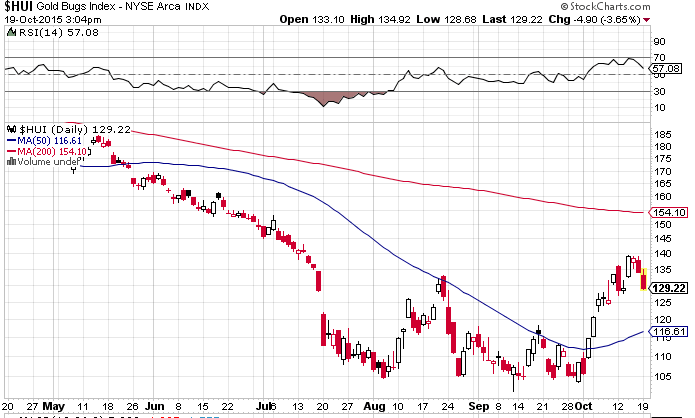
There is no definitive answer at this point, but consider that days like this happened quite often during even the fiercest parts of the last gold bull market as well. The bounce out of the October 2008 bottom exhibited plunges in the Gold Bugs Index (^HUI) very similar to what we saw today, on very minor down days for the metal itself. Even the final big run from July to September 2011 saw days where gold miners dropped 4%.

If the bear is intact, look for a break in the HUI to below 115. That is the most recent support zone that should stay solid if we are in a new bull market. There may be a brief break at that level just to clear sentiment and throw technical traders off who put all their apples in the support/resistance cart, but if the break is marginal and quickly reversed, we can continue higher from here to around 150 before the next resistance zone is tested.

HUI

Days like this being quite familiar to gold traders in the last four years, we should see bearish sentiment increase rather quickly and the 14 day RSI drop near 50 on the assumption the bear has resumed. This should give some running room for the next leg up by the end of this week or early next.

Keep in mind that the 115 level on the HUI index is also now the same as the upturning 50 day moving average. A new bull market should stay above that line in the sand, whereas a bear market really should have it turn back down again so the 50 cannot move above the 200. That type of move would be the ultimate confirmation of a new bull market, and we have a while to go before we get near that point.

The most important thing to watch on a daily level for now is what kind of move the HUI makes on the next up day for gold. Gold stocks need to be up big when the next up day hits. Otherwise, this could just be another bull trap.


Story continues below

A Deeper Look At The Market’s Irrational Response To The Latest Cempra Release

Cempra
Cempra

At the end of last week, Cempra, Inc. (NASDAQ:CEMP) announced the topline results from its latest trial of solithromycin for the treatment of patients with community acquired bacterial pneumonia. The company tanked on the release, currently trading at a close to 30% discount on prerelease levels. The decline came despite the trial meeting its primary endpoints, seemingly as a result of market focus on a particular element of the adverse events data associated with trial. However, a closer look at the numbers (and the fundamentals behind the numbers) suggests an oversell based on what, in this authors opinion, is relatively meaningless data. In turn, I believe now is a good time to gain exposure to what looks like a very promising treatment ahead of NDA submissions in both Europe and the US. So, with this said, let’s look at what the numbers actually show, and try to justify the argument that Cempra is cheap at current rates.

First, a look at the drug itself. Solithromycin is part of a class of drugs called macrolides – a type of treatment used to treat infections caused by gram positive bacteria. The mechanism of action is pretty complicated, but to simplify, they essentially stop bacteria from synthesizing proteins, which translates to a breakdown of the bacteria.

In the trial, Cempra compared solithromycin to moxifloxacin – a drug currently marketed by Bayer AG (OTCMKTS:BAYRY) and used across a range of indications, including the pneumonia indication being trialed. Cempra was targeting a primary endpoint of non-inferiority, which it met. This is the first important point. Moxifloxacin is a 15-year-old, established treatment in this space, known for its strong and consistent efficacy. In a recent telephone interview, Cempra management discusses the fact that the company could have chosen a weaker comparable and achieved superiority, but that a demonstrable non inferiority to moxifloxacin strengthens the drug’s NDA on FDA submission. The trial demonstrated the non inferiority required, which means the bet paid off.

So why the decline? Well, alongside the results announcement, Cempra reported that treatment related adverse events came in at 34.3% for solithromycin versus 13.1% for moxiflaxacin. Initially, this disparity looks alarming. However, the company also reported that the vast majority of these events were infusion site pain. Moxifloxacin is a type of drug called a fluoroquinolone – not a macrolide like solithromycin. Infusion site pain is far more commonly associated with macrolides than fluoroquinolone – I’m no scientist but will hazard a guess that this has something to do with the acidity of the solution being administered. In summary, that there was a higher rate of infusion site pain in the solithromycin arm is no real surprise – and is likely not enough to put the FDA or EMA off approving the treatment, at least not on its own. Further, the company can potentially reduce the infusion site pain by reducing infusion time. Reportedly, solithromycin is as effective wit ha 30-minute infusion time – not the 50 minutes used in the trial. The company only chose 50 minutes as this is the infusion time of moxiflaxacin. A 40% reduction in infusion time would (by way of reasonable conclusion) reduce the pain associated with infusion.

Another element of the press release that sellers focused was the reported supply issues. Most media outlets stopped at that term, without delving any deeper into how these arose. In a conference call that accompanied the announcement, management outlined the process through which physicians access the drug. Essentially, they have to through an online application with a “first rate global pharma supplier”. The supplier would then ship the assigned kit to the relevant location, across a spread of 140 sites. Out of 860 doses, there were two shipping holdups in Korea, two in Russia and one in Georgia. The issues did not relate to the treatment itself and likely have no bearing on Cempra’s ability to scale and ship if it reaches commercialization. Additionally, and playing into this element of the data, because physicians chose in each case to continue with SOC treatment for the patients discontinued through supply issues, they count as failures for solithromycin. That all five turned out to be solithromycin (the trial was blind, so we would expect at least one or two issues to have been moxifloxacin), and all count as a result not only to solithromycin’s detriment but in moxiflaxacin’s favor, is unlucky.

There are a few other elements that seem to have played into the downside move. First, the trial results look a little weak when compared to the company’s results from its oral version of the same treatment. This was fully expected, however, as macrolides are more effective as an oral administrable. There are, of course, many instances where oral administration is not possible. Another relates to the company’s wording in the following statement:

Treatment emergent ALT elevations were generally asymptomatic, reversible, and not associated with increased bilirubin.

The company has said it used the word “generally” as it has two more reviews to perform on the data before it can say for certain that ALT elevations were 100% asymptomatic, but it believes this to be the case, and is simply playing it safe by using the term it used.

There are more aspects that we could highlight, but the company intends to release and present further data in the coming weeks, so its probably beneficial to wait on this data before we dig any deeper. For now, let’s just say that it looks as though Cempra has lost close to $250 million in market capitalization on a market misinterpretation of trial data – or if not a misinterpretation, an over zealous focus on an essentially irrelevant element. The results are – as the press release states – promising, despite what the market thinks, and therein lies our opportunity.

Story continues below

Here’s A Near Term Opportunity In Oncology

Merrimack

Back in July, we published this piece highlighting Baxalta Incorporated (NYSE:BXLT) and its promising pipeline. One of the candidates we touched on was MM-398, the company’s co-development therapy with Merrimack Pharmaceuticals, Inc. (NASDAQ:MACK). The catalyst we were noted as the one to watch at the time was the FDA Prescription Drug User Fee Act (PDUFA) goal date, which was announced alongside the report that the FDA had granted the MM-398 NDA priority review status. The date we are looking at is October 24, and if we get some positive news, we could see a quick upside revaluation in the market cap of both companies. With this is mind, let’s look at the treatment in question, its performance in trials, and see if we can put an estimate on the likelihood of approval.

First up, a quick note for clarity. Most reading this will already know what is meant by PDUFA goal date, but for those not sure, it simply means the date by which the FDA must make its approval decision on newly developed therapies. Normally, it is ten months from the NDA submission, but in this instance (since MM-398 has accelerated review status) it is 6 months. Since this is the outer limit of the review period, we could see an announcement any time between now and then, so if you’re looking to take a position ahead of a potential approval, sooner is better than later to avoid missing out on the action.

So, MM-398. The drug under review for a pancreatic cancer indication, specifically for the treatment of sufferers that have already received gemcitabine treatment – a standard of care chemotherapy developed and currently marketed by Eli Lilly and Company (NYSE:LLY). The active element of MM-398 is called irinotecan, which is encapsulated inside a lipid casing in its ready-to-administer form. After administration, the irinotecan turns into something called SN-38, which is an inhibitor of an enzyme called topoisomerase – which is where this description of MM-398s MOA gets complicated. Topoisomerase is an enzyme responsible for releasing tension in DNA strands that have become “supercoiled” – an expression used to refer to the twisting of DNA as part of its replication process. Topoisomerase basically cuts the DNA strands into two pieces, unwinds them and reattaches them in an unwound fashion. It’s difficult to describe this any clearer with prose, but if you want some clarification, check out this video (it describes the process far better than we can!). By inhibiting this process in the cells of pancreatic cancer tumors, MM-398 (theoretically) can stop the cancerous cells replicating and halt progression of the cancer.

In the phase III on which Merrimack based its NDA submission, the treatment demonstrated statistically significant efficacy, and met both its primary and secondary endpoints, increasing overall survival from 4.2 months to 6.1 months when compared to a combination of 5-FU and leucovorin (a common chemo treatment for pancreatic cancer at the present). So we’ve got demonstrable efficacy – what about safety and tolerability? Well, chemotherapy treatments are notorious for adverse events, but the FDA will make its decision based on whether it believes the toxicity of the chemo drug is worth putting up with for the extension of survival it offers. In this instance, the most common side effect (20% of tested patients) was neutropenia, which is basically an increased susceptibility to infection. The FDA has approved many chemo drugs with neutropenia side effects in the past – indeed, the condition itself has drugs that treat it – so this shouldn’t be an issue when it come to MM-398.

So what’s the takeaway? Well – we’ve got about a week tops until we find out whether the FDA will approve MM-398. In its phase III, the treatment demonstrated statistically significant efficacy and Merrimack proved that adverse events are no more prevalent, and no more serious, than already approved treatments in the space. From a chance of approval perspective, things look promising. If we get approval, both Merrimack and Baxalta should receive a boost. Keep an eye on press releases from both companies between now and Friday next to see what happens.

Story continues below

Gold Slices Through Resistance as Mining Stocks Have Largest Rally Since 2011

gold mountain

The bottom in gold at $1080 just got a little firmer as the yellow metal broke through resistance at $1,170 today, trading nearly $20 higher on the day. Silver (NYSEARCA:SLV) broke through its own long term resistance as well, with precious metals stocks all showing signs of pulling away.

The junior miners (NYSEARCA:GDXJ) especially had enormous gains of 7.5% with the majors (NYSEARCA:GDX) rising “only” 6.5% by comparison. When juniors outpace majors on up days, this is also a good sign as junior mining companies are the marginal producers and therefore naturally the highest leveraged against gold. When majors outpace the juniors it can be a sign of an impending reversal. That did not happen today.

Pullbacks are common after days like this, so a strong down day tomorrow for gold stocks of up to 5% is not out of the question. If this is a new bull market though, some of today’s gains should be kept tomorrow even if there is a pullback.

International developments may be impacting moves to safety at this point, as bond funds also showed considerable strength today. The fact that Russia has sent its only aircraft carrier to Syria may be raising international jitters and causing gold prices to rise faster than they normally would have. An outbreak of war involving Russia would certainly put technical analysis to rest and cause investors to pour money into all safety assets.

Today marked another major achievement for the Gold Bugs Index (^HUI). The current rally off lows of 101.28 is now the largest rally by percentage (37%) since the gold bear market began in September 2011. So it is either the largest bear market rally in over four years, or it is the beginning of a new bull market.

Meanwhile, stocks did not follow gold higher today as the S&P 500 (NYSEARCA:SPY) closed down a half percent. Stocks were pulled down especially by retailers after Wal-Mart Stores, Inc. (NYSE:WMT) brought down the retail sector after collapsing 10%. Costco (NYSE:COST) and Target (NYSE:TGT) both traded down substantially, taking their cue from their larger competitor.

Barring any news of a conflict between the United States and Russia tomorrow, traders can expect a pullback in gold considering the advances made today. In order to keep a healthy wall of worry intact and prevent market crowding, gold will need something of a retreat from today’s gains to keep from attracting too much attention by emotional traders looking for a quick buck.

Disclosure: At the time of writing, the author was long precious metals stocks.

Story continues below

Why gold could eventually go to $6,500 an ounce

gold mountain

Gold (NYSEARCA:GLD) continued to drift lazily higher today without attracting too much attention to itself. It is still uncertain if a new bull market in precious metals has begun yet, but either way, it is useful to take a step back and consider a broader historical perspective to see what we may have in store this time around.

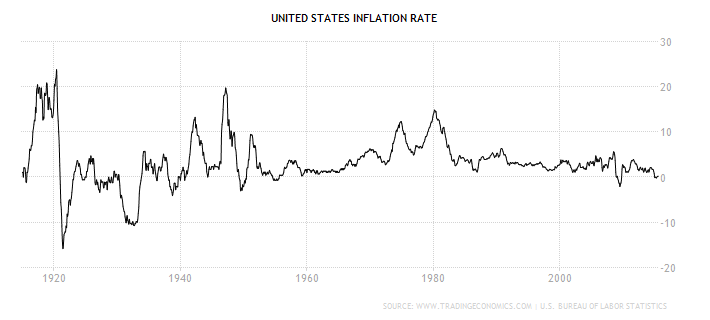
united-states-inflation-cpiThe chart above shows the United States inflation rate since the founding of the Federal Reserve in 1913. It reveals quite a few eye-openers. First, that the most extreme business cycle boom-bust was actually 1921 rather than 1929. In 1921, inflation went from 20% to nearly -20% in the space of a year. This was much worse than the Great Depression in intensity, though 1929 of course wins for duration.

As far as gold goes though, all business cycles before 1971 would not have had an effect on the gold price no matter how extreme simply because gold and the dollar were pegged back then at either $21 per ounce or $35 per ounce after President Franklin Roosevelt’s 1933 gold confiscation and devaluation. That being the case, inflation’s effect on the gold price would have to be analyzed after 1971 when President Richard Nixon finally delinked the dollar from gold, introducing pure fiat money.

It just so happens that gold’s peak on January 21, 1980 at $850 an ounce (over 5 times where it was just two years before) coincided with the highest post 1971 inflation rate print ever. What this shows is that when inflation becomes patently obvious, gold goes parabolic in a true sense. The bad news for gold bulls back then was that then-Fed Chair Paul Volcker was pushing interest rates even higher than the inflation rate in an attempt to calm the CPI and save the dollar.

While that approach did save the dollar, it destroyed the gold bull market.

This time around, there is no possible way to raise interest rates significantly if inflation pulls above 5%. The debt is too large, and saving the dollar that way will destroy the bond market. Sadly, inflation will destroy the bond market on its own anyway, putting US Treasuries in a conundrum.

Gold prices may have bottomed, and they may have not yet. But what is certain is that if and when inflation inches above 5%, there will be virtually no way to save the dollar this time without linking it directly to a commodity. The Fed cannot even hike rates a measly 25 basis points let alone to nearly 20% as Volcker did. Volcker-era interest rates are an impossibility, a non-starter. If ever the CPI climbs at a rate of 5% or higher annually, we may even see a repeat of the 1980 parabolic move in gold, but this time with no way to bring it back down.

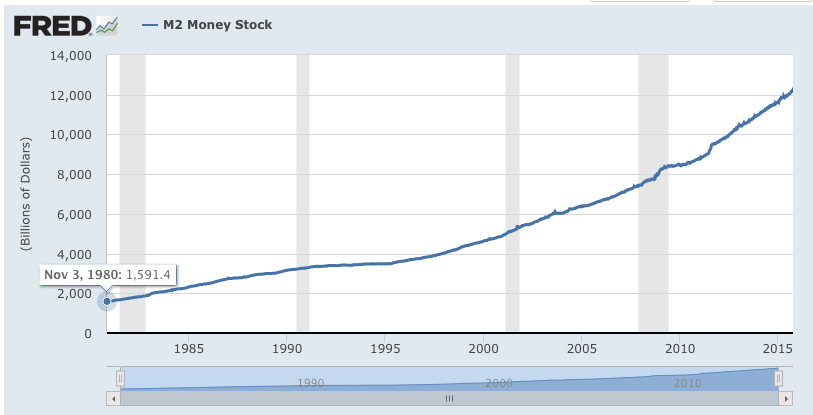
The result would be a fundamental revaluation of gold in dollar terms and the relinking of paper to metal. At what price exactly? Well, in 1980, the money supply totalled $1.6 trillion (see below), and gold maxed out at $850 an ounce.

M2 Historical ChartThe dollar supply now is about $12.1 trillion, which means that if there ever is runaway inflation, gold should max out somewhere around $6,500 an ounce. This also makes sense considering that the gold price increased by a factor of 5 in the two years leading up to January 21, 1980. In today’s numbers, a 5-fold increase would take us to around $6,000, so this is the neighborhood we are looking at if faith in the dollar is ultimately lost and the only option to save it is to return to a gold standard.

Disclosure: The author was long precious metals at the time of writing. 


Story continues below

Is There Opportunity In The Latest Eli Flop?

eli Lilly

So yesterday morning we learnt that Eli Lilly and Company (NYSE:LLY) was dumping its lead cholesterol candidate after it failed to produce any level of statistically significant efficacy in phase III trials. The announcement came premarket, and Eli stock lost nearly 10% before the bell rang. The company closed out the day about 8% down on last week’s close, with more than 26 million shares traded – five times average daily volume. Needless to say, markets were expecting big things from the dropped candidate, and it failed to deliver. As we head into a fresh day’s trading, the question now is why did Eli drop evacetrapib, and what impact might it have on the company and its strategy going forward? Additionally, where can we look to take advantage of the announcement? Let’s take a look.

First, the drug in question. Evacetrapib is one of a range of drugs that have been/are being investigated by a number of big pharma organizations that falls under the category of cholesteryl ester transfer protein (CETP) inhibitor. There are a few different types of cholesterol, some good, some bad. CETP transfers cholesterol from high density (a good type) to low density (a bad type). By inhibiting this process, drug companies hoped to be able to improve cholesterol levels and – in turn – reduce heart disease and other cardiovascular issues.

Pfizer (NYSE:PFE) was the first company to try and bring CETP inhibitors to market, with its candidate torcetrapib way back in 2006. In a startlingly similar fashion to Eli, however, the company announced a discontinuation of a phase III in December of that year, citing an increased mortality rate as the root cause. While Eli hasn’t yet announced the specifics of its latest failed trial, it has not mentioned mortality as a driver behind the decision; instead, insufficient efficacy based on the advice of an independent review panel. From a social perspective, the fact that the drug didn’t have any mortality side effects is a good thing, of course. Fro an investment perspective, however, inefficacy and increased mortality rates are interchangeable – they both translate to wasted capital. Again, exactly how much wasted capital remains unclear. We do know, however, that Pfizer spent circa $800 million bringing torcetrapib to its halted phase III, and that the Eli trial was conducted across a wider patient sample. We can reasonably conclude that Eli has spent this figure or more on development – the company has reported a Q4 charge of up to $90 million on its earnings as a result of the discontinuation, but this far from reflects the overarching cost of the drugs development when everything is accounted for. There is also a missed opportunity cost. Across the drug’s development, markets have slowly been pricing in the potential for a billion-dollar minimum boost to Eli’s annual revenues. The whole situation also places a negative spotlight on Eli’s macro strategy. The company has been very public about its intentions to focus on potential blockbusters, regardless if development cost. It has justified this approach through the claim that it focuses on only drugs with a high chance of trial success. With the latest failure, markets will question Eli’s judgment when it comes to future candidates.

So is there any opportunity to profit from this development? Well, maybe. Eli still has a strong pipeline, and while it wont be generating revenues from the CETP space going forward, a 10% decline in its market capitalization looks like an oversell. Additionally, it opens up an opportunity for a couple of shorts. Merck & Co. Inc. (NYSE:MRK) has a CETP candidate in ongoing trials, and with both Pfizer and Eli already having discontinued their respective candidates, the likelihood of Merck doing the same has increased. Amgen (NASDAQ:AMGN) is also set to suffer, with the company having picked up the rights to the then Dezima owned CETP candidate TA-8995 last month.

What can we take away from all this?  Well, this is a high profile flop for Eli, and could well be the nail in the coffin for the CETP class, but it may offer an opportunity to pick up an exposure to the biotech incumbent at a discount. The company still has some strong candidates in its self styled to-the-moon pipeline, and even against the backdrop of this miss, all it will take is one hit to catalyze an upside revaluation. This said, expect further selling pressure in Eli stock near term, likely to compound when the company gets around to releasing the specifics of the evacetrapib trial.

Story continues below

Gold Bottom Watch, 2008 vs Now

Gold Bull

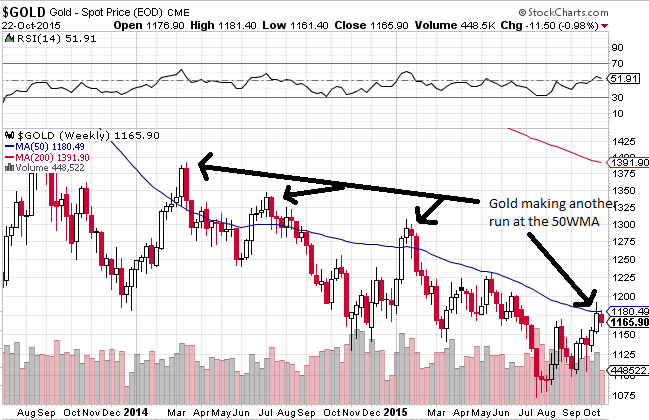
Gold continues to drift off its bottom of $1,080.80 an ounce hit on July 24. We are now about 7.5% off those lows, and it has taken us two and a half months to get there. If this is indeed a bottom it is very unlike the 2008 bottom hit on October 22.

On October 22, 2008, the SPDR Gold Trust (NYSEARCA:GLD) traded in a range of 14% in a single day, closing more than 8% off its lows that day. That’s more than gold has moved up since the recent bottom over 2 months ago. The October 2008 bottom was a bottom that resembled a rubber ball being slammed to the floor and bouncing right back up. Gold’s action since July has resembled more of the proverbial climb of the wall of worry.

The difference between 2008 and now is that 2008 was not a bear market bottom, because there was no gold bear market in 2008. It was the end of a correction, and it ended with a very strong bounce. The last true gold bear market bottom ended with a slow climb from 1999 until 2002. Bear markets don’t usually end with strong bounces, but with slow gradual climbs like we are seeing now.

The Gold Bugs Index (^HUI) is still outperforming gold by a large margin of 28% to 7.5%, still consistent with bull market action. Today’s pullback in the major gold miners (NYSEARCA:GDX) despite gold’s continued slow push higher should not be viewed as anything more than a technical pullback following gold’s failed push through resistance at $1,170. Immediately upon hitting that number in the futures market, the metal traded down immediately as technical traders sold at resistance, with gold stocks taking the brunt of the selloff. If this keeps happening then it could signal trouble, but once is no cause for alarm.

The $1,170 area has been serving as key resistance since late 2014 and if and when gold breaks through that barrier, the chances of the final bottom already being printed rise even more. We hit that level today and bounced back down again, but it is very unusual for any asset class that has been in a protracted bear to break through resistance on the first try. The next time $1,170 is approached, gold should break through, assuming we are in a new bull market.

What we should see now is another few days of basing until gold makes another run at $1,170. When it breaks through, we should also see commenters and analysts trying to pick a top, which should signal that the wall of worry is still intact.

The less bullish people become as the gold price rises, the higher the chances are that we are actually in a new gold bull market rather than a bear market rally.


Story continues below

Monday’s Movers and Shakers in Biotech

biotech

For a number of companies, the close of last week brought with it considerable volatility in biotech. For some, the volatility added some much needed strength against a backdrop of the weakening wider biotech space. For others, there came no such reprieve, and for one in particular, Friday will be looked back on as a black day. So, with this said, let’s take a look at what went on in biotech.

Nobilis Health Corp. (NHC.TO)

First then, let’s look at Nobilis. From highs a little ahead of $7 flat on Friday morning, Nobilis crashed to close out the day at $4.93 – a 30% decline in a matter of hours. As is its prerogative, the Investment Industry Regulatory Organization of Canada (“IIROC”) halted trading mid session, stemming what could have been an even deeper decline. The organization reinstated trading at market close, which gave Nobilis the weekend to report its take on the drop. Despite having this time, however, the company kept quiet, only reporting that it was not aware of any material development that drove the decline. For those not familiar with Nobilis, the company is a healthcare marketing company that delivers pharmaceutical marketing direct to patients via hospitals it owns, manages and partners with. The question we need to ask now is whether the decline is the beginning of a larger bear trend, or whether it is an anomaly that, in turn, offers an opportunity to pick up an exposure at a discount. Well, in the last 12 months the company has grown its revenues from less than $20 million to more than $60 million as reported last quarter. The recent decline means the company is trading at a market cap of a little over 6 X revenues, which if the decline does turn out on anomaly, looks attractive. Of course, there may be something we don’t know. It might be worth waiting on any updates before taking on this amount of risk.

LDR Holding Corporation (NASDAQ:LDRH)

Next up, LDR. This company designs and develops medical devices targeted at improving the surgical biotech space, with a specific focus on the spine. The company is set to report its Q3 2015 earnings on November 4, 2015, and it announced some preliminary expectations on Friday. The expectations missed considerably on the numbers offered as guidance by analysts that follow the company, and this translated to an immediate downside hit for LDR throughout Friday’s US session. The company declined from Friday’s open at $36 flat to close out the day a little over $26 – a 28% decline across the session. Exactly what the markets will make of LDR as we head into a fresh session is unclear, but from an objective perspective the decline looks a little harsh. Yes, the company missed on expectations, but only by a few percentage points, and still expects to report quarterly revenues of a little over $40 million – a circa 10% gain on the comparable quarter last year. With this in mind, the decline may be an exaggerated response to an earnings surprise in the wake of the bearish wider biotech sentiment, and once again, might offer a nice discounted exposure for the more risk tolerant biotech investor. Just as with Nobilis, however, there is an addendum. Selloffs will often breed collateral selloff, so a little patience might be worth a lot before deciding on, or against, an exposure.

Eli Lilly and Company (NYSE:LLY)

Moving to the mega caps, let’s close this one out with Eli Lilly. As with the other two, Eli lost a considerable portion of its market capitalization, in this instance pre market today – declines that look set to continue as we head into today’s session. The company announced before market open that it was pitching to discontinue the development of evacetrapib – its lead cholesterol candidate. Eli announced its phase III trial, which has taken place across more than 500 sites and more than 12,000 patients, will be discontinued on the back of a lack of demonstrable, statistically significant efficacy. Investors had been looking to the drug as a potential exposure to a multi billion-dollar industry, and having spent triple digit millions on evacetrapib to date, have taken a big hit on its discontinuation. The company’s stock has reacted accordingly, with premarket showing a close to 8% decline on Friday’s close. Expect further declines during today’s US session, as investors that picked up an exposure in anticipation of the treatment’s phase III success cut losses and limit damages.


Story continues below